
ToeyToey.
IELTS
TOEIC
Speaking
PricingBlog
Log in
Start free
ToeyToey.

Your AI English coach for TOEIC, IELTS and Speaking — practice, instant feedback, and a plan, all in one place.

Product

  • Listening
  • Reading
  • Speaking
  • Writing
  • Grammar
  • Vocabulary
  • Practice tests

Resources

  • Blog
  • IELTS Writing Samples
  • IELTS Speaking Samples
  • IELTS Tools
  • What's new
  • Study plan
  • Pricing

About

  • About us
  • Contact
  • Feedback

Legal

  • Terms of Service
  • Privacy Policy
  • Commercial Disclosure

© 2026 Toey. All rights reserved.

IELTS is a registered trademark of the University of Cambridge, the British Council, and IDP Education Australia. This site and its owners are not affiliated, approved or endorsed by the University of Cambridge ESOL, the British Council, or IDP Education Australia.

ETS®, TOEIC® and TOEFL® are registered trademarks of Educational Testing Service (ETS). This website is not endorsed or approved by ETS.

DashboardMy planMock testsExam Mode
Home/IELTS/Writing Samples/Academic Task 1
Academic Task 1

IELTS Academic Writing Task 1: Silkworm Life Cycle & Silk Production (Band 9 Sample)

This Academic Task 1 shows two diagrams: the life cycle of the silkworm and the process of making silk cloth from its cocoon. A band-9 response makes clear that the first is a cycle and the second a linear sequence, then reports the stages of each in order using the present passive and sequencing language. Below is a model answer of roughly 175 words, followed by why it scores 9 on all four criteria.

Get your own IELTS essay graded by AI

Band scores on all four criteria, line-by-line corrections and a model rewrite — free to start.

Grade my essay free

01 · The task

The diagrams below show the life cycle of the silkworm and the stages in the production of silk cloth. Summarise the information by selecting and reporting the main features, and make comparisons where relevant.
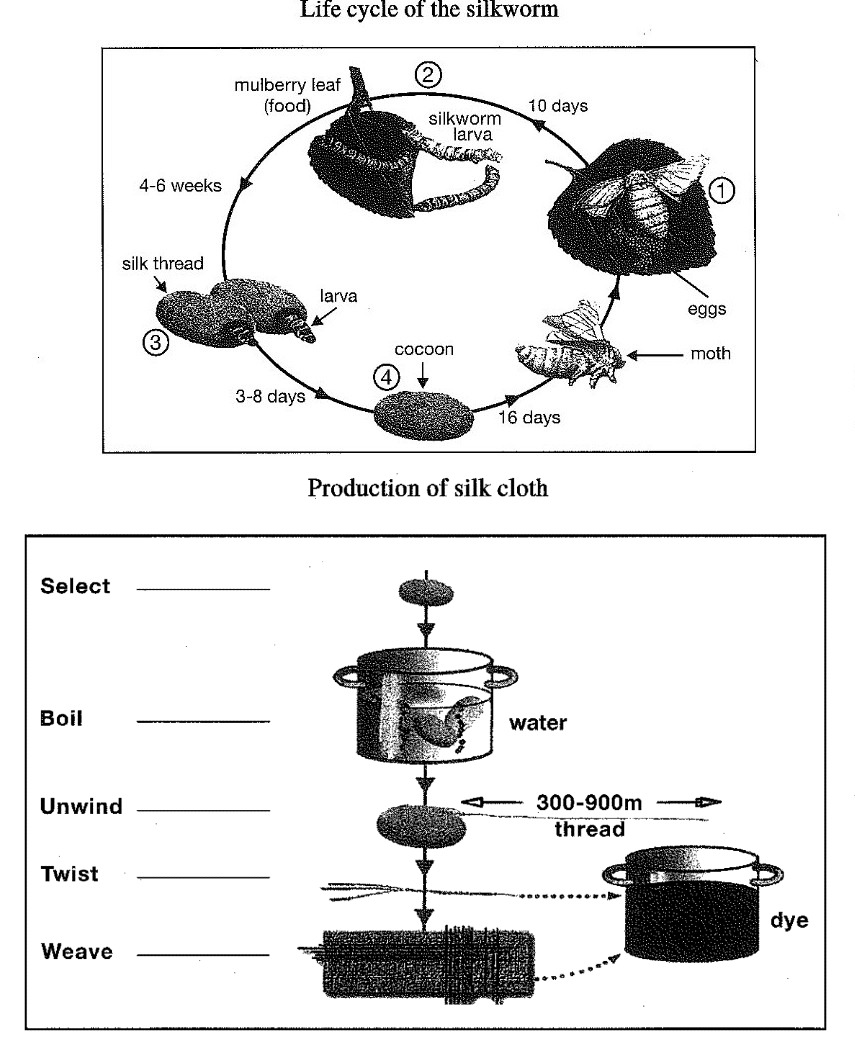
Two diagrams about silk. The first shows the four-stage life cycle of the silkworm: a moth lays eggs, which hatch into larvae after about ten days; the larvae feed on mulberry leaves for four to six weeks, then spin a silk-thread cocoon over three to eight days, and after sixteen days a moth emerges from the cocoon, beginning the cycle again. The second shows the five linear stages of making silk cloth: cocoons are selected, boiled in water, unwound to release 300 to 900 metres of thread, twisted, and finally woven into cloth and dyed.

02 · Band 9 sample answer

174 words · Band 9

The two diagrams illustrate, firstly, the natural life cycle of the silkworm and, secondly, the manufacturing process by which its cocoon is turned into silk cloth.

Overall, the life cycle is a continuous loop with four stages, whereas silk production is a linear process of five steps. Together, they show how a natural material is harvested from an insect and then processed by hand into finished cloth.

The life cycle begins when a moth lays eggs, which hatch into silkworm larvae after around ten days. The larvae then feed on mulberry leaves for four to six weeks before spinning a cocoon of silk thread over the next three to eight days. Sixteen days later, an adult moth emerges from the cocoon, and the cycle starts afresh.

In the production of silk cloth, the cocoons are first selected and then boiled in water. Next, each cocoon is carefully unwound to yield a single thread of between 300 and 900 metres, which is subsequently twisted for strength. Finally, the thread is woven into cloth and dyed.

03 · Why this scores Band 9

Task Achievement

The response covers both diagrams, opens with an overview that correctly distinguishes the cyclical life cycle from the linear production process, and then reports every stage of each in order, including the key timings (ten days, four to six weeks, sixteen days) and the 300–900 metre thread length. It selects the main stages rather than over-describing.

Coherence & Cohesion

The report is cleanly divided — overview, then one paragraph per diagram — and each follows the ideal process shape. Sequencing language is varied and accurate — "begins when...", "then feed on...", "before spinning...", "Sixteen days later...", "first selected and then boiled...", "Next...", "subsequently...", "Finally".

Lexical Resource

Process vocabulary is precise and varied — "hatch into larvae", "feed on mulberry leaves", "spinning a cocoon", "emerges from the cocoon", "unwound to yield a single thread", "twisted for strength", "woven into cloth and dyed" — using accurate verbs rather than a single repeated word.

Grammatical Range & Accuracy

The present passive is used correctly for the production process — "are first selected and then boiled", "is carefully unwound", "is subsequently twisted", "is woven into cloth and dyed" — while the life cycle uses the active present for a natural process ("a moth lays eggs", "the larvae feed on..."). A relative clause ("which hatch into silkworm larvae") adds range, and the writing is error-free.

04 · Useful collocations for this task

Tap a phrase to see what it means and how to use it. Natural collocations like these lift your Lexical Resource score.

05 · Frequently asked questions

How do I handle a question with two separate diagrams?

Cover them separately after a combined overview — one paragraph each. In the overview, note how they relate; here, one is a natural cycle and the other a manufacturing process, and together they trace silk from insect to cloth.

How do I show that one diagram is a cycle?

Say so in the overview ("a continuous loop") and end that paragraph by noting the cycle "starts afresh". For the linear process, use a clear start-to-finish sequence with "first... next... finally".

What tense and voice should I use?

Present simple throughout. Use the passive for the human-run production process ("the cocoons are boiled"), and the active for the natural life cycle ("the moth lays eggs"). Keep both consistent.

How long should a Task 1 answer be?

At least 150 words; a band-9 answer is usually 170–200. This model is 174 words, enough to cover both diagrams stage by stage. Spend about 20 minutes on Task 1.

Want feedback on your own answer?

Toey grades your essay on Task, Coherence, Lexical Resource and Grammar, then shows exactly how to reach the next band — free to start.

Try the free IELTS Writing grader

More Academic Task 1 samples

  • IELTS Writing Task 1: Line Graph (Band 9 Sample Answer)
  • IELTS Writing Task 1: Bar Chart (Band 9 Sample Answer)
  • IELTS Writing Task 1: Table (Band 9 Sample Answer)
  • IELTS Writing Task 1: Process Diagram (Band 9 Sample)
  • IELTS Writing Task 1: Map (Band 9 Sample Answer)
  • IELTS Academic Writing Task 1: Household Appliances & Housework Line Graph (Band 9 Sample)
  • IELTS Academic Writing Task 1: Urban Population Line Graph (Band 9 Sample)
  • IELTS Academic Writing Task 1: Community Centre Activities Line Graph (Band 9 Sample)
  • IELTS Academic Writing Task 1: Industrial Area Map (Band 9 Sample)
  • IELTS Academic Writing Task 1: Library Then & Now Map (Band 9 Sample)
  • IELTS Academic Writing Task 1: US Household Income Bar Chart (Band 9 Sample)
  • IELTS Academic Writing Task 1: Plastic Bottle Recycling Process (Band 9 Sample)
  • IELTS Academic Writing Task 1: Graduate Destinations Pie Chart & Table (Band 9 Sample)
  • IELTS Academic Writing Task 1: Shop Closures & Openings Line Graph (Band 9 Sample)
  • IELTS Academic Writing Task 1: Sugar Production Process (Band 9 Sample)
  • IELTS Academic Writing Task 1: US Jobs by Sector Line Graph (Band 9 Sample)
  • IELTS Academic Writing Task 1: Instant Noodles Process (Band 9 Sample)
  • IELTS Academic Writing Task 1: Harbour Map Changes (Band 9 Sample)
  • IELTS Academic Writing Task 1: Biofuel (Ethanol) Production Process (Band 9 Sample)
  • IELTS Academic Writing Task 1: Rain-Shadow Desert Formation (Band 9 Sample)
  • IELTS Academic Writing Task 1: Café Redesign Map (Band 9 Sample)
  • IELTS Academic Writing Task 1: Nutrients by Meal Pie Charts (Band 9 Sample)
  • IELTS Academic Writing Task 1: Police Budget Table & Pie Charts (Band 9 Sample)
  • IELTS Academic Writing Task 1: Dance Classes Pie & Bar Chart (Band 9 Sample)
  • IELTS Academic Writing Task 1: Family Spending Bar Chart (Band 9 Sample)
  • IELTS Academic Writing Task 1: Metal Prices Line Graph (Band 9 Sample)
  • IELTS Academic Writing Task 1: Library Users Pie & Table (Band 9 Sample)
  • IELTS Academic Writing Task 1: Dependent Population Bar Chart (Band 9 Sample)
  • IELTS Academic Writing Task 1: School Spending Pie Charts (Band 9 Sample)
  • IELTS Academic Writing Task 1: Consumer Expenditure Table (Band 9 Sample)
  • IELTS Academic Writing Task 1: Qualifications by Gender Bar Chart (Band 9 Sample)
  • IELTS Academic Writing Task 1: Reasons for Migration Pie Charts (Band 9 Sample)
  • IELTS Academic Writing Task 1: Global Water Use Graph & Table (Band 9 Sample)
  • IELTS Academic Writing Task 1: How a Smokehouse Works Diagram (Band 9 Sample)
  • IELTS Academic Writing Task 1: Land Degradation Pie & Table (Band 9 Sample)
  • IELTS Academic Writing Task 1: Rainwater Recycling Process (Band 9 Sample)
  • IELTS Academic Writing Task 1: Japanese vs American Office Plans (Band 9 Sample)
  • IELTS Academic Writing Task 1: School Site Map Changes (Band 9 Sample)