
IELTS Academic Writing Task 1: Rainwater Recycling Process (Band 9 Sample)
This Academic Task 1 asks you to describe a diagram showing how rainwater is collected and treated to become drinking water in a house. A band-9 response opens with an overview of the whole process, then reports the stages in order using the present passive and sequencing language. Below is a model answer of roughly 175 words, followed by why it scores 9 on all four criteria.
Get your own IELTS essay graded by AI
Band scores on all four criteria, line-by-line corrections and a model rewrite — free to start.
01 · The task
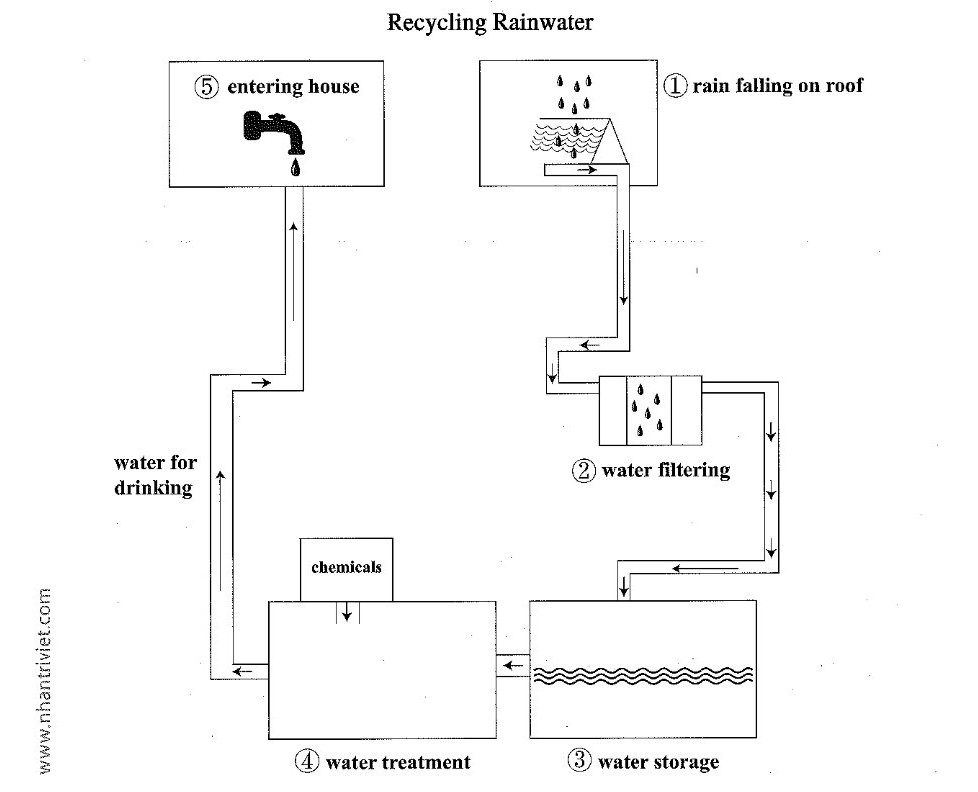
The diagram below shows how rainwater is collected and recycled to be used as drinking water in a house. Summarise the information by selecting and reporting the main features, and make comparisons where relevant.
02 · Band 9 sample answer
177 words · Band 9The diagram illustrates the process by which rainwater is captured from a roof and treated so that it can be used as drinking water inside a house.
Overall, the process is linear and consists of five main stages, beginning with the collection of rain on the roof and ending with clean water being delivered from a household tap. It combines simple physical collection with a purification phase.
At the first stage, rain falls on the sloped roof of the house and is channelled away for collection. The water is then directed through a filter, which removes leaves and other debris. From there, it flows into a storage tank, where it is held until needed.
In the second phase, the stored water is passed to a treatment unit, where chemicals are added to purify it and make it safe to drink. Finally, the treated water is pumped back up into the house, where it emerges from a tap as clean drinking water. In this way, rainwater that would otherwise run to waste is turned into a usable supply.
03 · Why this scores Band 9
The response covers the whole process, opens with an overview that states the number of stages and groups them into collection and purification phases, and then reports every key step in the correct order — roof, filter, storage, chemical treatment and delivery. It selects the main stages rather than over-describing minor details.
The report follows the ideal process shape — introduction, overview, then the stages in sequence. Sequencing language is varied and accurate — "At the first stage", "The water is then directed...", "From there", "In the second phase", "Finally", "In this way" — so the reader follows the flow from roof to tap.
Process vocabulary is precise and varied — "captured from a roof", "channelled away", "directed through a filter", "removes debris", "held until needed", "chemicals are added to purify it", "run to waste" — using accurate verbs rather than a single repeated word.
The present passive is used correctly throughout — "is channelled away", "is then directed through a filter", "is held until needed", "chemicals are added", "is pumped back up" — exactly as a process description requires. A relative clause ("a filter, which removes leaves and other debris") and a final "In this way" clause add range, and the writing is error-free.
04 · Useful collocations for this task
Tap a phrase to see what it means and how to use it. Natural collocations like these lift your Lexical Resource score.
05 · Frequently asked questions
What tense and voice should I use for a process diagram?
Use the present simple passive throughout ("the water is filtered", "chemicals are added"), because the focus is on what happens at each stage, not who does it. This is the single most important grammatical feature of a process answer.
How do I show the order of the stages?
Use sequencing words — "first", "then", "from there", "finally" — and vary them rather than repeating "then". Varying the connectors keeps the report cohesive, which this model does deliberately.
Do I need an overview for a process?
Yes — always. State how many stages there are, whether it is linear or a cycle, and where it begins and ends. Here the overview also groups the stages into a collection phase and a purification phase, which lifts the report.
How long should a Task 1 answer be?
At least 150 words; a band-9 answer is usually 170–200. This model is 177 words, enough for an overview and all five stages in order. Spend about 20 minutes on Task 1.
Want feedback on your own answer?
Toey grades your essay on Task, Coherence, Lexical Resource and Grammar, then shows exactly how to reach the next band — free to start.
Try the free IELTS Writing grader