
IELTS Academic Writing Task 1: Japanese vs American Office Plans (Band 9 Sample)
This Academic Task 1 asks you to compare two office floor plans — a typical Japanese office and a typical American one. A band-9 response gives an overview of the key difference in layout, then describes each plan and draws comparisons using language of location. Below is a model answer of roughly 175 words, followed by why it scores 9 on all four criteria.
Get your own IELTS essay graded by AI
Band scores on all four criteria, line-by-line corrections and a model rewrite — free to start.
01 · The task
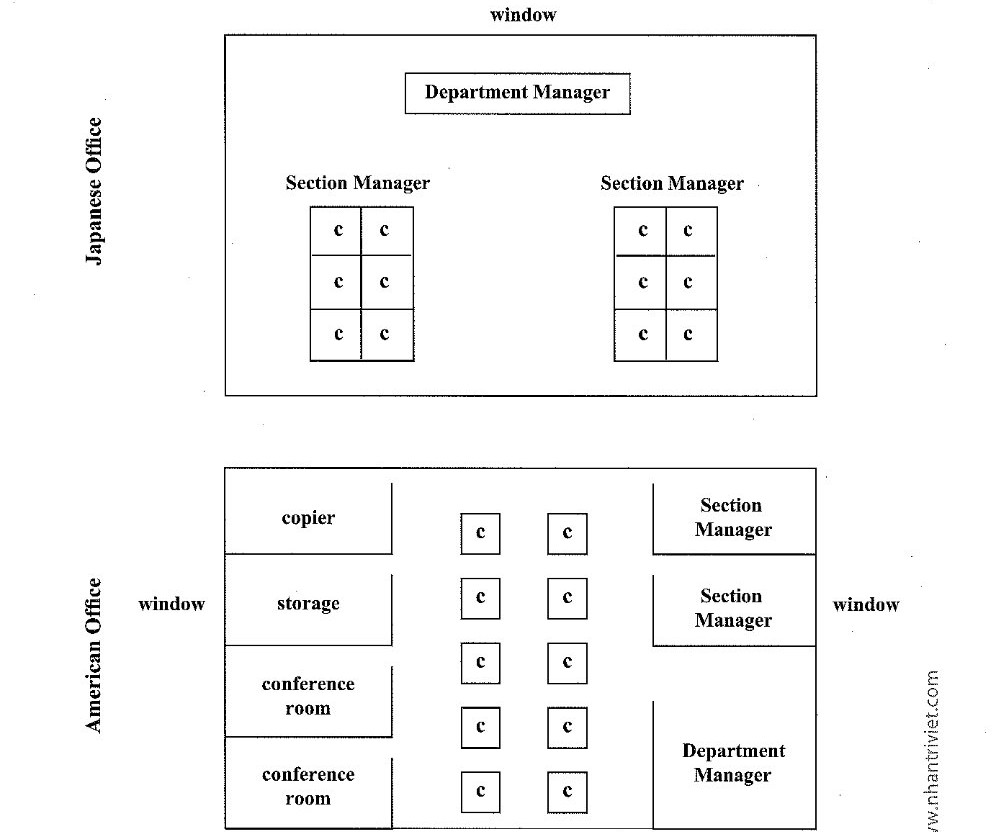
The two plans below show the typical layout of a Japanese office and an American office. Summarise the information by selecting and reporting the main features, and make comparisons where relevant.
02 · Band 9 sample answer
175 words · Band 9The two plans compare the typical layout of a Japanese office with that of an American office.
Overall, the most striking difference lies in how the two cultures organise space: the Japanese office is entirely open-plan, with managers seated among their teams, whereas the American office is divided into separate, enclosed rooms that give managers and staff their own space.
In the Japanese office, everyone shares a single large room. The department manager's desk sits at the top, near the window, while the two section managers are positioned in the open, each heading a cluster of six employee desks grouped closely together. There are no internal walls, so the whole team works side by side.
The American office, by contrast, is heavily compartmentalised. The two section managers and the department manager each occupy a private office along the right-hand wall, and the opposite wall is lined with a copier, a storage room and two conference rooms. Between them, the ordinary employees work at individual desks arranged in two rows down the centre of the room.
03 · Why this scores Band 9
The response describes both plans fully, opens with an overview that captures the central contrast (open-plan versus compartmentalised), and then reports the position of managers, staff and rooms in each, drawing clear comparisons. It selects the meaningful structural differences rather than listing every desk.
The report is logically split — overview, then one paragraph per office. Location language guides the reader throughout — "at the top, near the window", "in the open", "along the right-hand wall", "the opposite wall", "down the centre of the room" — giving each layout a clear spatial structure, with "by contrast" marking the shift.
Vocabulary is precise and idiomatic — "open-plan", "seated among their teams", "a cluster of... desks grouped closely together", "no internal walls", "heavily compartmentalised", "occupy a private office" — describing spatial arrangement without repetition.
A range of structures presents the layouts accurately: a "whereas" contrast ("whereas the American office is divided into separate, enclosed rooms"), a result clause ("There are no internal walls, so the whole team works side by side"), and a passive of position ("the opposite wall is lined with a copier, a storage room and two conference rooms"). The writing is error-free.
04 · Useful collocations for this task
Tap a phrase to see what it means and how to use it. Natural collocations like these lift your Lexical Resource score.
05 · Frequently asked questions
How do I organise a comparison of two floor plans?
State the key difference in the overview, then take one paragraph per plan, moving through each in a consistent spatial order (e.g. by wall or area). Grouping by plan and using clear location phrases reads far better than jumping between the two.
What tense should I use?
The present simple, because the plans describe general, current layouts rather than a change over time ("the manager sits at the top", "the wall is lined with..."). Keep it consistent throughout.
Should I interpret why the layouts differ?
A brief framing is fine — noting that the layouts reflect different ways of organising space — but keep the focus on describing what the plans actually show. Task 1 rewards accurate reporting, not speculation about culture.
How long should a Task 1 answer be?
At least 150 words; a band-9 answer is usually 170–200. This model is 175 words, enough for an overview and a full description of both layouts. Spend about 20 minutes on Task 1.
Want feedback on your own answer?
Toey grades your essay on Task, Coherence, Lexical Resource and Grammar, then shows exactly how to reach the next band — free to start.
Try the free IELTS Writing grader