
IELTS Writing Task 1: Process Diagram (Band 9 Sample)
This Academic Task 1 is a process diagram rather than a data chart, so a band-9 response describes the stages in sequence using the passive voice and time markers — no numbers or trends. The model paraphrases the diagram, gives a two-stage overview, then walks through the day and night cycle. It is about 190 words.
Get your own IELTS essay graded by AI
Band scores on all four criteria, line-by-line corrections and a model rewrite — free to start.
1The task
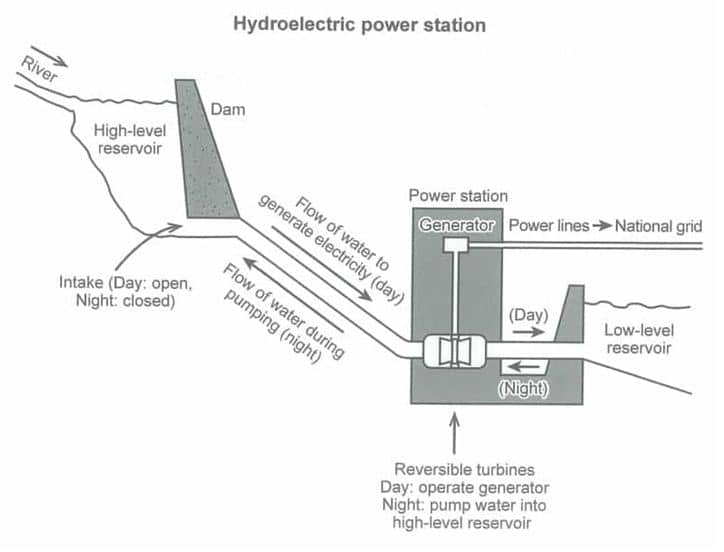
The diagram below shows how electricity is generated in a hydroelectric power station. Summarise the information by selecting and reporting the main features and make comparisons where relevant.
2Band 9 sample answer
189 words · Band 9The diagram illustrates how electricity is produced at a hydroelectric power station. It is a man-made, cyclical process that operates in two opposite phases, one by day and one by night.
1Overview
Overall, during the day water stored at height is released to drive turbines and generate power, whereas at night those same turbines are reversed to pump the water back up, allowing the whole cycle to be repeated.
2The day and night cycle
At the centre of the system is a dam, which holds back a high-level reservoir fed by a river. During the daytime, the intake is opened and water flows downhill under gravity into the power station, where it passes through reversible turbines. These turbines spin a generator, and the electricity produced is then carried along power lines to the national grid. Having done its work, the water drains into a low-level reservoir below.
At night, when demand for electricity is low, the process is reversed. The intake is closed and the turbines act as pumps, forcing the water from the low-level reservoir back up to the high-level reservoir. The station is thus recharged, ready to generate power again the following day.
3Why this scores Band 9
1Task Achievement
Every stage is covered in the correct order — reservoir, intake, turbines, generator, grid, low-level reservoir, and the night-time pumping — and the key point that the process is a repeating cycle is made explicit in the overview, which is what a band-9 process answer requires.
2Coherence & Cohesion
Time and sequence markers ("During the daytime", "then", "Having done its work", "At night", "thus") move the reader through the process step by step, and the day/night contrast is signalled clearly with "whereas" and "the process is reversed".
3Lexical Resource
Process-appropriate verbs are precise and varied — "holds back", "flows downhill under gravity", "passes through", "drains into", "forcing the water … back up" — avoiding repetitive "then … then". Register stays natural, not showy.
4Grammatical Range & Accuracy
The passive voice is used accurately throughout for an impersonal process ("the intake is opened", "the electricity produced is carried"), alongside a relative clause ("a dam, which holds back …") and a participial opener ("Having done its work …"). The description is error-free.
4Useful collocations for this task
Tap a phrase to see what it means and how to use it. Natural collocations like these lift your Lexical Resource score.
5Frequently asked questions
How is a process diagram different from a chart?
There are no numbers or trends to report. Instead you describe the stages in order, usually in the passive voice, and state whether the process is natural or man-made, linear or cyclical. Your overview names the main stages rather than the highest value.
Should I use the passive voice?
Mostly, yes. A process is impersonal, so "the intake is opened" reads more naturally than "someone opens the intake". Mix in active verbs for the water itself ("the water flows", "spins the turbines") to keep it varied.
How long should Academic Task 1 be?
At least 150 words in about 20 minutes; a band-9 answer is typically 170–200 words. This model is 189 words.
Do I need an overview for a process?
Yes. State how many main stages there are and the overall nature of the process (here, a repeating day/night cycle). It is still the single most important feature examiners check for.
Want feedback on your own answer?
Toey grades your essay on Task, Coherence, Lexical Resource and Grammar, then shows exactly how to reach the next band — free to start.
Try the free IELTS Writing grader