
IELTS Writing Task 1: Map (Band 9 Sample Answer)
This Academic Task 1 shows two maps of the same place at different times, so a band-9 response compares them using the past and present, the passive voice, and location language — describing what has changed rather than reporting numbers. The model is about 185 words.
Get your own IELTS essay graded by AI
Band scores on all four criteria, line-by-line corrections and a model rewrite — free to start.
1The task
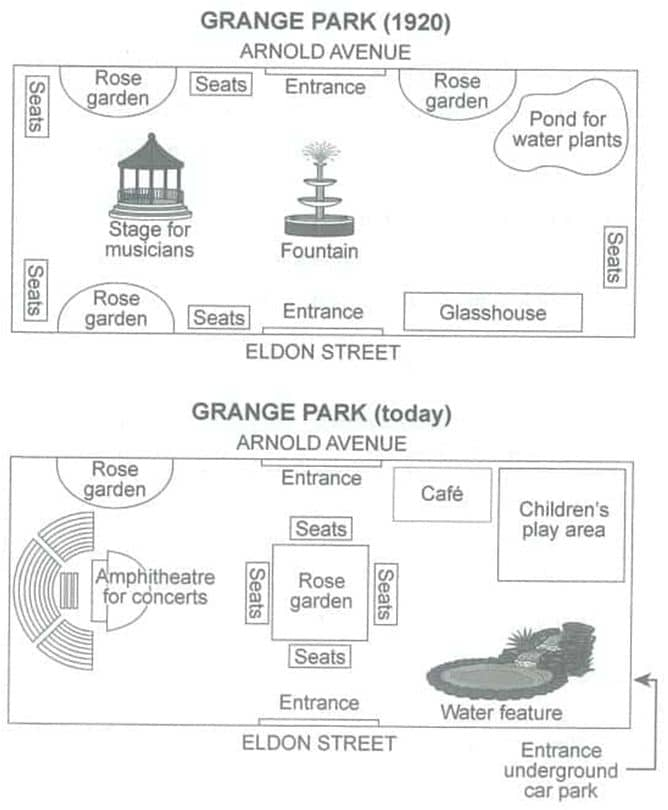
The plans below show a public park when it first opened in 1920 and the same park today. Summarise the information by selecting and reporting the main features and make comparisons where relevant.
2Band 9 sample answer
183 words · Band 9The two plans compare the layout of a public park, Grange Park, as it was when it opened in 1920 with how it appears today.
1Overview
Overall, although the park has kept its rectangular shape and its two entrances on Arnold Avenue and Eldon Street, almost all of its interior features have been redeveloped, largely replacing decorative and horticultural areas with facilities for recreation.
2Key changes
Several of the park’s original attractions have disappeared. The ornamental fountain that once stood in the centre has been replaced by a rose garden surrounded by seats, while the stage for musicians on the western side has been converted into a much larger amphitheatre for concerts. The four rose gardens of 1920 have also been reduced to a single one.
The eastern half has changed the most. The pond for water plants in the north-east has made way for a café and a children’s play area, and the glasshouse in the south-east is now a water feature. A significant addition is an entrance to an underground car park on the eastern boundary, a facility the original park did not have.
3Why this scores Band 9
1Task Achievement
The response selects the significant changes — the fountain, stage, pond, glasshouse and the new car park — and also notes what stayed the same (the shape and entrances). The overview captures the overarching shift from decorative to recreational use, which is exactly what a band-9 map answer needs.
2Coherence & Cohesion
Changes are grouped logically (central features, then the eastern half) and located precisely with compass and position language ("in the centre", "on the western side", "in the north-east"). Linkers such as "while", "also" and "A significant addition" connect the ideas naturally.
3Lexical Resource
Change vocabulary is varied and accurate — "has been replaced by", "converted into", "reduced to", "made way for", "is now" — so no single verb is repeated. Location phrasing is precise and register natural, with no forced words.
4Grammatical Range & Accuracy
The present perfect passive is used correctly to describe completed changes ("has been converted", "have been reduced"), alongside a relative clause ("the fountain that once stood in the centre") and a contrastive "although" clause in the overview. The description is error-free.
4Useful collocations for this task
Tap a phrase to see what it means and how to use it. Natural collocations like these lift your Lexical Resource score.
5Frequently asked questions
What tense do I use for a map showing two time periods?
Use the past (or present perfect) for the changes — "the fountain was removed", "a café has been built" — and the passive voice, since the focus is on what was changed rather than who changed it. If a map shows a future plan, use the future or modal forms instead.
Should I describe both maps separately?
No. Compare them feature by feature — what each area used to be and what it is now — as this model does. A change-by-change comparison scores far higher than describing map one and then map two.
How long should Academic Task 1 be?
At least 150 words in about 20 minutes; a band-9 answer is typically 170–200 words. This model is 183 words.
Do I need to mention things that stayed the same?
Yes, briefly. Noting what was retained — here, the shape and the two entrances — shows full coverage, but most of your answer should focus on the changes, which are the significant features.
Want feedback on your own answer?
Toey grades your essay on Task, Coherence, Lexical Resource and Grammar, then shows exactly how to reach the next band — free to start.
Try the free IELTS Writing grader