Navigating IELTS Reading: Skimming vs Scanning Explained
Sixty minutes. Forty questions. Three dense academic passages (or, in General Training, a mix of notices, letters, and longer articles). The IELTS Reading section is a time management challenge as much as a language challenge — and the single biggest reason candidates run out of time is that they read everything at the same speed, the same way.
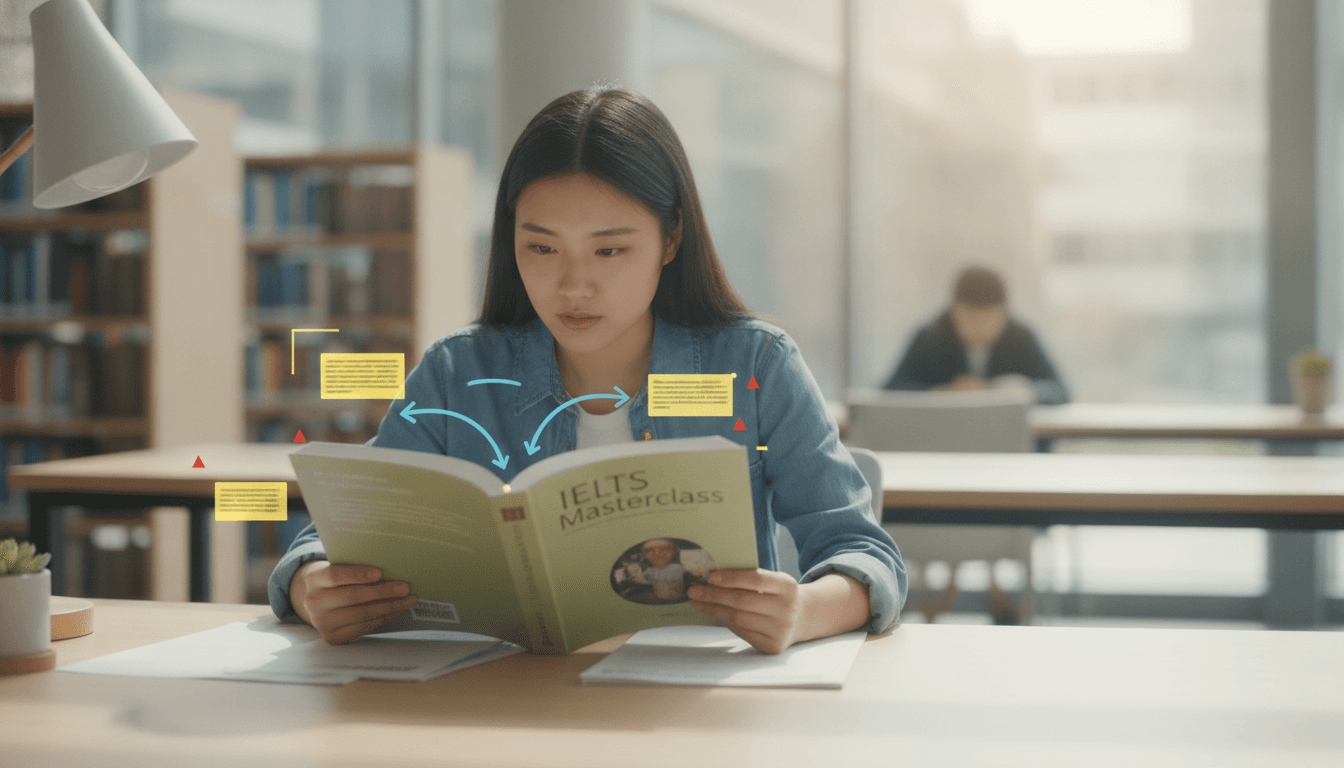
That's where skimming and scanning come in. These aren't just vague test-taking tips. They are distinct cognitive strategies, each suited to a different job, and knowing which one to deploy — and when — is what separates a Band 6 reader from a Band 7+ reader.
Let me break both down clearly.
What Skimming Actually Is (And What It Isn't)
Skimming means reading quickly to build a general understanding of the text's structure and main ideas — not to find a specific fact, and definitely not to understand every word. Think of it as taking a bird's-eye view of the passage before you land.
Why does this matter in IELTS? Because IELTS Reading questions are rarely in the same order as the information in the passage. If you dive straight into Question 1 without any map of the text, you'll be hunting blind. A 60-second skim of a passage gives you a mental index: paragraph A is about causes, paragraph B shifts to consequences, paragraph C introduces a counterargument. That index saves you minutes later.
How to skim effectively:
- Read the title and any subheadings — these are your chapter markers.
- Read the first sentence of each paragraph only. Academic writers almost always front-load their main idea (the topic sentence).
- Glance at the final sentence of the passage — it often signals the author's conclusion or overall stance.
- Do NOT read every example, every statistic, every subordinate clause. Let them blur.
Here's the mindset shift: you are not trying to understand the passage. You are trying to understand the map of the passage.
The first sentence of a paragraph often signals its entire purpose — e.g., "However, critics of this approach argue that the benefits are overstated." tells you the paragraph is a counterargument, without reading another word.
A common mistake I see is candidates skimming so fast they absorb nothing — eyes moving, brain disengaged. Skimming is still active reading. You're making quick decisions: Is this paragraph relevant to the question I'm about to answer? That requires real mental engagement, just applied selectively.
What Scanning Actually Is
Scanning is the opposite operation. You already have a specific target — a name, a date, a keyword, a number — and you move your eyes rapidly across the text until that target appears. You are not reading for meaning; you are pattern-matching.
This is the technique you use after you've read a question and identified what kind of information you need. The question tells you the target; scanning finds it.
How to scan effectively:
- Before you scan, identify your target precisely. If the question asks about "the year the policy was introduced," your target is a four-digit number. If it asks about "the researcher who challenged the theory," your target is a proper noun (capitalised).
- Let your eyes move in a Z-pattern or column sweep — don't read left to right word by word. Let the target "pop" visually.
- Use synonyms and paraphrases as secondary targets. IELTS rarely repeats the question's exact wording in the passage. If the question says "increase," the passage might say "rise," "surge," or "grow."
Q (True/False/Not Given): The government introduced the carbon tax in 2008. Scan target: a year near 2008, or the phrase "carbon tax" — whichever is rarer in the passage and therefore easier to spot.
That last point about synonyms is critical. Scanning for the exact words from the question is a trap — IELTS question writers deliberately paraphrase. Train yourself to scan for the concept, not the string of letters.
When to Use Which — The Practical Sequence
Here's the workflow I'd recommend for each passage, based on how the official IELTS task types are structured:
Step 1 — Skim the passage (60–90 seconds max) Build your mental map. Note where topics shift. Don't read the questions yet — read the passage first so you're not biased by what the questions ask.
Step 2 — Read the questions as a group Understand what each question is actually asking. Underline the key noun or concept in each question. This becomes your scan target.
Step 3 — Return to the passage and scan For each question, go to the section of the passage your skim told you is relevant, then scan for your target. You're not re-reading the whole passage — you're navigating to a zone and then zooming in.
Step 4 — Read carefully only when you've located the zone Once scanning brings you to the right paragraph or sentence, then you read carefully — two or three sentences — to confirm the answer. This is the only moment of slow, deliberate reading.
The mistake most candidates make is skipping Steps 1 and 2 and going straight to slow reading from the top. That's how you spend 25 minutes on one passage and panic through the last two.
Question Types and Which Technique They Demand
Not all IELTS Reading question types call for the same approach. Here's how to match technique to task:
Matching Headings — This is a pure skimming task. You need the main idea of each paragraph, not specific details. Read the first (and occasionally last) sentence of each paragraph, match it to a heading, move on.
True / False / Not Given and Yes / No / Not Given — Skim to locate the relevant section, then scan for your key concept, then read carefully to judge whether the passage supports, contradicts, or simply doesn't mention the claim. The "Not Given" trap catches people who scan too fast and assume absence of an exact phrase means "False" — it doesn't.
Short Answer / Sentence Completion — Heavy scanning tasks. The question gives you a very specific information gap (a number, a name, a process step). Scan hard for your target type, then read the surrounding sentence carefully to confirm.
Summary Completion — Skim to identify which part of the passage the summary covers, then scan within that section. The order of the summary usually follows the order of the passage, which helps.
For a sentence completion question like "The study found that sleep deprivation reduced reaction times by ______." — your scan target is a percentage, a number, or a unit of measurement near the phrase "reaction time" or its synonym. You're not re-reading the whole passage; you're hunting a very specific shape of information.
The Synonym Problem — Why Your Scan Fails
This deserves its own section because it's the most common reason scanning doesn't work for IELTS candidates.
IELTS question writers are trained to paraphrase. The passage and the question will almost never use the same words. If you scan only for the question's exact vocabulary, you will miss the answer.
Here's how to build your synonym awareness:
- When you read the question, immediately ask: What are two or three other ways to say this?
- Common IELTS paraphrase patterns: increase → rise, grow, surge, climb; problem → challenge, issue, drawback, obstacle; study → research, investigation, analysis, survey.
- Proper nouns (people's names, place names, brand names) are usually not paraphrased — they're your most reliable scan anchors.
This is why building your lexical resource — the same criterion scored in IELTS Writing — also pays dividends in Reading. The wider your vocabulary, the faster you recognise paraphrases when scanning.
A Note on Academic vs General Training Reading
The skimming and scanning strategies above apply to both versions of the test, but the text types differ. Academic Reading uses three long, complex passages drawn from journals, magazines, and books — dense vocabulary, long sentences, abstract arguments. General Training Reading starts with shorter functional texts (notices, advertisements, workplace documents) before moving to longer articles.
For General Training, skimming is often faster because the shorter texts in Section 1 and 2 have clearer visual structure (headings, bullet points, labels). Scanning is especially effective there — a notice about gym opening hours, for example, is almost entirely a scanning task. For the longer Section 3 passage, treat it exactly like an Academic passage.
Putting It Together: A Realistic Time Budget
For Academic Reading, here's a realistic time split across the 60 minutes:
- Passage 1 (usually easiest): ~17 minutes — 90 sec skim, ~15 min questions
- Passage 2 (medium difficulty): ~20 minutes — 90 sec skim, ~18 min questions
- Passage 3 (usually hardest): ~20 minutes — 90 sec skim, ~18 min questions
- Buffer: ~3 minutes to transfer answers / check
If you're on paper-based IELTS, remember: unlike Listening, there is no separate answer transfer time for Reading — you write directly onto the answer sheet as you go. Don't leave everything to the last two minutes.
The discipline here is not about reading faster. It's about reading less — trusting your skim, trusting your scan, and only slowing down when you've already found the right place in the text.
That shift in mindset — from "I must understand everything" to "I must find what each question needs" — is what makes the difference.
Frequently asked questions
Should I skim the passage before reading the IELTS Reading questions?
Yes — a 60–90 second skim of the passage before you look at the questions gives you a mental map of where topics are located. This makes scanning for specific answers much faster later, because you already know which paragraph to target.
Why does scanning for exact question words not always work in IELTS Reading?
IELTS question writers deliberately paraphrase the passage. The question might say 'increase' while the passage says 'surge' or 'climb.' You need to scan for the concept and its synonyms, not just the exact string of words from the question.
Which IELTS Reading question types require skimming versus scanning?
Matching Headings is primarily a skimming task — you need paragraph main ideas, not details. Short Answer, Sentence Completion, and True/False/Not Given are primarily scanning tasks where you hunt for a specific fact, name, or number before reading carefully to confirm.
Is there a difference in strategy between Academic and General Training IELTS Reading?
The core skimming and scanning strategies are the same. However, General Training Section 1 and 2 texts (notices, letters, ads) are shorter and visually structured, making scanning especially quick. Section 3 of General Training should be treated like an Academic passage — skim first, then scan per question.
How much time should I spend skimming each IELTS Reading passage?
Aim for no more than 60–90 seconds per passage. Focus on the title, subheadings, and the first sentence of each paragraph. The goal is a rough mental map, not comprehension — you're building an index, not reading the passage.
Toey
Verified coachToey is an AI-powered IELTS & TOEIC prep platform. Our guides are written with examiner-informed criteria and tested against thousands of real practice attempts.