Navigating IELTS Reading: Time Management Strategies That Actually Work
Sixty minutes. Forty questions. Three dense Academic passages — or a mix of notices, letters, and articles in General Training. If you've ever hit question 30 with eight minutes left on the clock, you already know the problem. IELTS Reading doesn't reward the best reader in the room; it rewards the reader who manages time well enough to reach every question.
I built Toey because I kept seeing the same pattern: test-takers who understood the language perfectly but still lost marks because they ran out of time. This post is my attempt to fix that — with specific strategies grounded in how the test is actually designed.
Why Time Pressure Hits Harder Than You Expect
The maths looks fine on paper: 60 minutes ÷ 3 passages = 20 minutes each. But that calculation ignores a crucial detail — the passages get progressively harder. Passage 3 in Academic IELTS routinely contains more abstract vocabulary, longer sentences, and question types (like Matching Information or Yes/No/Not Given) that demand careful re-reading.
If you spend 25 minutes on Passage 1 because it felt manageable, you've already borrowed time you don't have. The fix isn't to rush Passage 1 — it's to set a hard exit time for each passage and honour it, even if you haven't answered every question.
Also worth noting: unlike the Listening section, there is no separate answer-transfer time in IELTS Reading. You write your answers directly on the answer sheet as you go. Every second counts from the moment the clock starts.
The 20-20-20 Rule — and When to Break It
The standard advice is 20 minutes per passage. That's a reasonable baseline, but I'd refine it:
- Passage 1 (Academic) or Section 1 (General): aim for 17–18 minutes. These are designed to be more accessible. Banking 2–3 minutes here is free time for later.
- Passage 2: stick close to 20 minutes. Difficulty ramps up; don't let yourself linger.
- Passage 3: use whatever remains — ideally 22–23 minutes. This is where most marks are lost, so give it the most runway.
The underlying principle: allocate time in proportion to difficulty, not in equal thirds. This is a small shift, but it consistently helps test-takers avoid the scenario where Passage 3 gets only 12 minutes.
Skim First — But Skim With Purpose
A lot of candidates either skip skimming entirely (and drown in detail from line one) or skim so vaguely that it wastes time. Neither works.
Effective skimming in IELTS Reading means spending 60–90 seconds on a passage to extract:
- The topic and main argument — usually in the first paragraph and the final paragraph.
- The structure — how many sub-sections are there? Are there subheadings? This becomes your mental map when you're hunting for specific information later.
- Tone shifts — does the writer contradict something in paragraph 4? Knowing this saves you from choosing the wrong Yes/No/Not Given answer.
You are not reading for detail at this stage. You are building a map so that when a question sends you back into the text, you know roughly where to look — which is the single biggest time-saver in the section.
Read the Questions Before You Read the Passage (With One Exception)
For most question types — True/False/Not Given, Short Answer, Sentence Completion, Matching Headings — reading the questions first gives you a target. You know what you're hunting before you enter the text.
The question asks: "What reason does the author give for the decline in coral reef coverage?"
With that in mind, your eyes naturally scan for cause-and-effect language (due to, as a result of, led to) rather than reading every sentence at equal weight.
The exception: Matching Headings. For this question type, read the passage first (or at least each paragraph's first and last sentence), then match. Trying to pre-read six or seven heading options and then read the passage creates cognitive overload and slows you down.
Don't Read — Scan and Locate
This is the mindset shift that separates a Band 6 reader from a Band 7+ reader in terms of time efficiency. IELTS Reading is not a comprehension exercise the way a school exam is. It is an information retrieval exercise with a time constraint.
For factual questions, the answer exists in a specific location in the text. Your job is to locate that location fast. Train yourself to:
- Follow proper nouns, numbers, and capitalised words — these are almost never paraphrased, so they're your fastest anchors.
- Recognise paraphrases of the question in the passage — the question says "cost" and the passage says "expenditure"; the question says "children" and the passage says "young people under the age of 12".
Question: In which year did the company first expand overseas? Passage excerpt: "By 1998, the firm had established its inaugural international branch in Singapore."
The word "first" maps to "inaugural" and "overseas" maps to "international" — the number 1998 is your answer. Recognising that paraphrase quickly is the skill.
The Two-Pass Technique for Hard Questions
Every IELTS Reading section contains a handful of questions that are genuinely difficult — either because the answer requires synthesising two parts of the passage, or because the Not Given option is designed to look like False.
Spending four minutes on one hard question is a catastrophic time decision. Here's the protocol I recommend:
Pass 1: Work through the questions in order. If a question takes more than 90 seconds and you still don't have a confident answer, mark it, write your best guess on the answer sheet, and move on.
Pass 2: If you finish the passage with time remaining, return to the flagged questions. Now you've seen the full passage, and sometimes a later paragraph clarifies what an earlier question was asking.
The key insight: a guess recorded is worth more than a blank. IELTS Reading has no negative marking. You lose nothing by guessing — but you lose potential marks by leaving a blank while you agonise.
Timed Practice: The Right Way to Build Speed
Practising under timed conditions is obvious advice. Here's the non-obvious part: the debrief matters more than the practice session itself.
After every timed practice passage, log:
- How many minutes did you spend on each passage?
- Which question types cost you the most time?
- Were the questions you got wrong ones you didn't know, or ones you ran out of time for?
Those three data points tell you exactly where to direct your next week of preparation. If you consistently overspend on Matching Information questions, that's a specific skill to drill — not "reading" in general.
For source material, use Cambridge IELTS Official Practice Tests (books 1–18 are available). These are the closest to real test conditions because they are real test conditions — retired papers released by Cambridge. Third-party materials vary wildly in difficulty calibration.
General Training Reading: Same Clock, Different Challenge
General Training candidates face the same 60-minute window but a different passage structure: Section 1 contains short texts (notices, advertisements, timetables), Section 2 contains workplace-related texts, and Section 3 is a longer article similar in difficulty to Academic passages.
The time strategy shifts slightly:
- Section 1 should take no more than 12–14 minutes. The texts are short and the questions are often straightforward matching tasks. This is your fastest section — treat it as a time bank.
- Section 2: around 18–20 minutes.
- Section 3: the remaining time, ideally 26–28 minutes, since it mirrors Academic difficulty.
General Training candidates often underestimate Section 3 because the earlier sections felt easy. Don't let a comfortable start lull you into spending too long on Section 2.
A Note on Word Limits in Short-Answer Questions
This isn't strictly a time management point, but it costs marks in a time-management-adjacent way: always check the word limit instruction before answering short-answer or sentence-completion questions.
If the instruction says "NO MORE THAN TWO WORDS" and you write three words — even if the third word is technically accurate — the answer is marked wrong. Scanning for and respecting that instruction takes five seconds and can save you one or two marks per section.
Putting It Together: A Session Checklist
Rather than a vague reminder to "practise regularly," here is a concrete structure for a single productive IELTS Reading practice session:
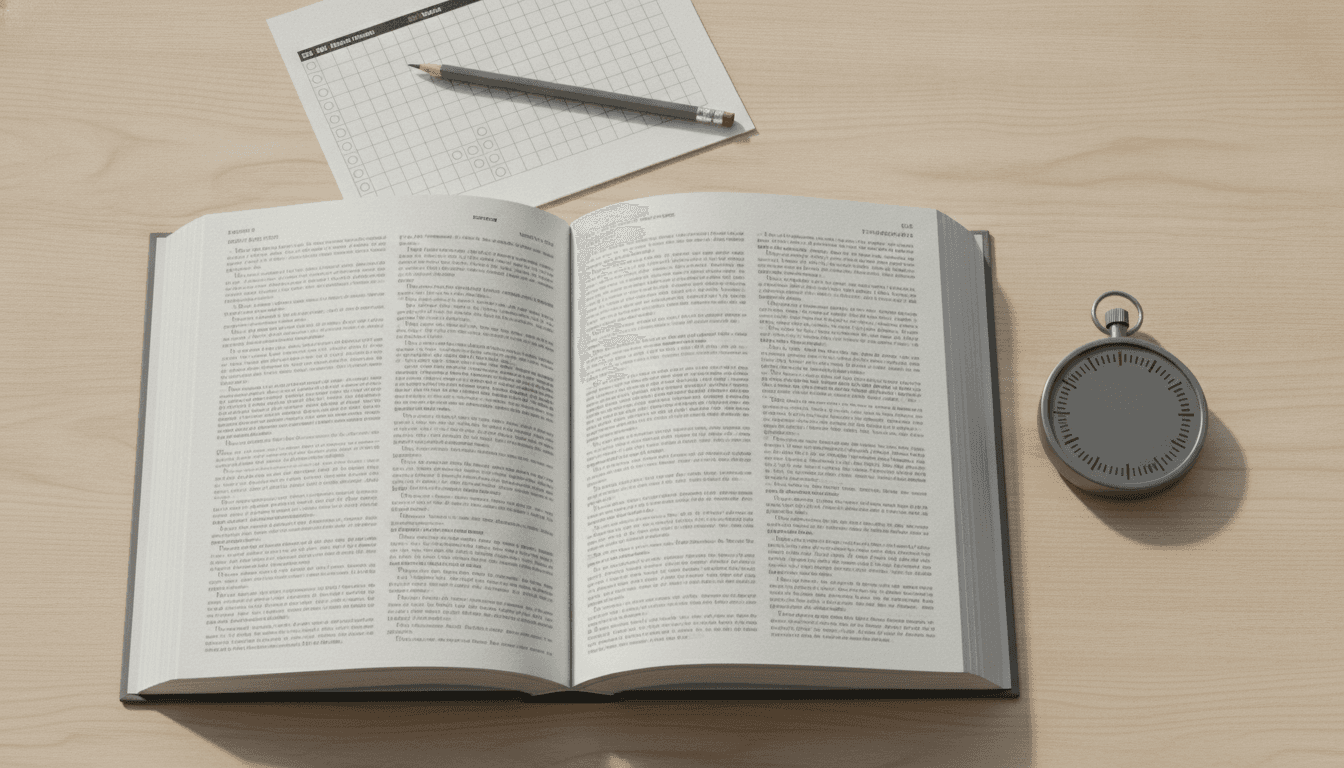
- Set a timer for exactly 60 minutes. No pausing, no looking up words mid-test.
- Allocate your time before you start: write "P1: finish by 18 min / P2: finish by 38 min / P3: finish by 60 min" at the top of your paper.
- Use the two-pass technique on any question that stalls you past 90 seconds.
- After the timer ends: mark your answers against the key, then spend 20–30 minutes on the debrief — identifying which question types cost you time and which answers you got wrong despite having time.
- Repeat twice a week with fresh Cambridge Official Practice Test passages.
The goal of each session isn't just a score — it's a clearer picture of your specific time leaks. Fix those leaks systematically, and the score follows.
IELTS Reading rewards disciplined time allocation more than raw reading speed. Once you internalise that — and build a consistent pre-test ritual around it — the 60-minute window stops feeling like a threat and starts feeling like a structure you control.
Frequently asked questions
How should I split my time across the three IELTS Reading passages?
A good baseline is 17–18 minutes for Passage 1, 20 minutes for Passage 2, and 22–23 minutes for Passage 3. This accounts for the fact that difficulty increases with each passage — banking a couple of minutes on the easier first passage gives you more runway for the hardest third passage.
Is there extra time to transfer answers in IELTS Reading?
No. Unlike the paper-based Listening test, IELTS Reading gives you no separate answer-transfer time. You must write your answers directly onto the answer sheet as you work through each passage within the 60-minute window.
Should I read the questions or the passage first in IELTS Reading?
For most question types (True/False/Not Given, Short Answer, Sentence Completion), read the questions first so you know what to look for. The exception is Matching Headings — for that type, read each paragraph's first and last sentence before looking at the heading options, to avoid cognitive overload.
What should I do if I get stuck on a difficult IELTS Reading question?
Use the two-pass technique: if a question takes more than 90 seconds without a confident answer, write your best guess on the answer sheet, mark the question, and move on. Return to flagged questions only after completing the rest of the passage. There is no negative marking in IELTS Reading, so a guess is always better than a blank.
What is the best material to use for timed IELTS Reading practice?
Cambridge IELTS Official Practice Tests (the numbered Cambridge IELTS series, books 1–18) are the most reliable source because they are retired real test papers released by Cambridge. Third-party materials vary significantly in how accurately they reflect actual test difficulty and question style.
Toey
Verified coachToey is an AI-powered IELTS & TOEIC prep platform. Our guides are written with examiner-informed criteria and tested against thousands of real practice attempts.