
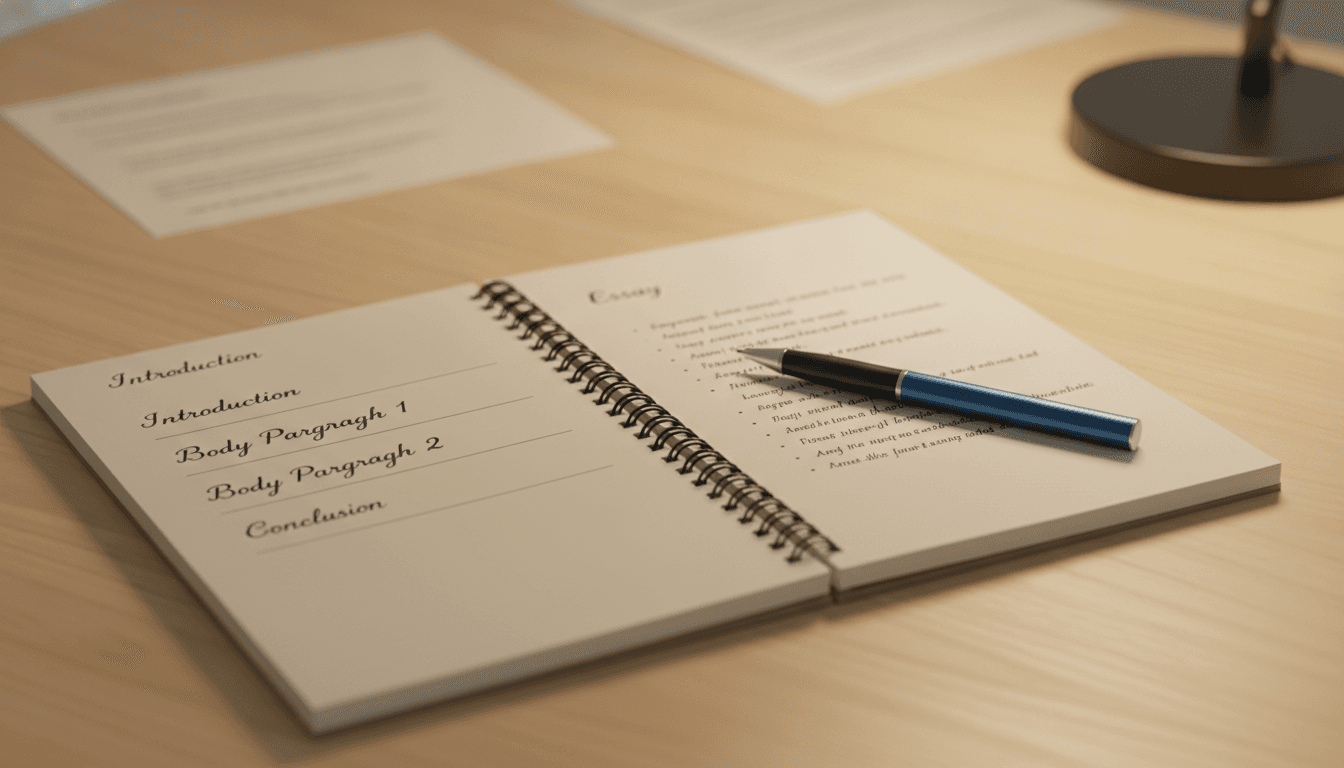
Crafting the Perfect IELTS Task 2 Argument: A Step-by-Step Guide
IELTS Writing Task 2 is worth more than most people realise. Because it is double-weighted against Task 1, your essay alone can swing your Writing band by a full point in either direction. That is a big deal — and yet the most common mistake I see is treating Task 2 like a school composition: write an introduction, list some opinions, wrap it up. That approach rarely breaks Band 6.
What the examiners are actually looking for is a reasoned argument — one that takes a clear position, develops it logically, and holds together from the first sentence to the last. This guide walks you through exactly how to do that, based on the four official scoring criteria: Task Response, Coherence & Cohesion, Lexical Resource, and Grammatical Range & Accuracy.
Start With the Task Response — Before You Write a Single Word
Task Response is criterion one, and it is the foundation everything else rests on. A Band 7 descriptor for Task Response says the candidate "addresses all parts of the task" and presents "a clear position throughout." The word throughout is doing a lot of work there.
Before you write, spend two to three minutes dissecting the prompt. Most Task 2 questions fall into a handful of types: opinion/argument ("To what extent do you agree?"), discussion ("Discuss both views"), problem-solution, and two-part question. Each type demands a different structural commitment.
For an opinion essay, you must pick a side — genuinely. Examiners penalise vague, both-sides-are-valid non-answers because the prompt explicitly asks for your view. If you hedge throughout the essay, your Task Response score drops regardless of how elegant your sentences are.
A practical move: write your thesis in one sentence before you plan anything else. That sentence becomes your anchor. Every body paragraph should serve it.
The government, not the individual, bears primary responsibility for addressing climate change because systemic problems require systemic solutions.
That is a clear, arguable position. You can plan three paragraphs around it immediately.
Build Each Body Paragraph Around One Central Claim
This is where most mid-band essays fall apart. Writers introduce a claim, give one vague example, then pivot to a loosely related idea in the same paragraph. The result reads as underdeveloped — and underdevelopment is explicitly flagged in the Band 6 Task Response descriptor ("main ideas but they are not sufficiently developed").
The fix is a tight paragraph architecture: Claim → Explanation → Evidence/Example → Link back to thesis. This is not a rigid formula; it is a logical sequence. You make a point, explain why it is true, show it in action, then remind the reader why it matters to your overall argument.
Here is what that looks like in practice:
Governments possess the regulatory power to enforce large-scale emissions reductions that individual behaviour change cannot achieve. A single household switching to renewable energy saves a negligible amount of carbon; a national policy mandating clean energy standards for industry can cut emissions by millions of tonnes annually. This asymmetry means that waiting for consumer-led change is not a viable climate strategy — structural intervention is essential.
Notice that the paragraph never drifts. It opens with a claim, explains the mechanism (regulatory power vs. individual action), gives a concrete contrast to make the scale tangible, and closes by tying back to the thesis. That is a Band 7+ paragraph.
Aim for two or three body paragraphs of this quality rather than four thin ones. Depth beats breadth in Task 2.
Coherence & Cohesion: The Invisible Architecture
Coherence & Cohesion is the criterion that separates essays that feel easy to read from those that feel like a struggle. Coherence refers to the logical flow of ideas; cohesion refers to the linguistic devices — connectors, pronouns, reference words — that stitch sentences together.
The most common cohesion mistake is over-relying on a small set of discourse markers: Furthermore, Moreover, In addition, However. Examiners notice this. The Band 7 descriptor specifically requires cohesive devices to be used "flexibly." Flexibility means varying your tools.
Some underused but effective cohesive devices:
- Pronoun reference: "This asymmetry means..." (referring back to the contrast just made)
- Lexical repetition with variation: Instead of repeating "government" three times, alternate with "policymakers," "authorities," "the state"
- Logical connectors that show cause: "As a result," "This leads to," "Consequently" — not just addition markers
- Concession + rebuttal: Acknowledge a counter-argument briefly, then dismiss it with evidence. This actually strengthens your position.
Admittedly, individual choices — dietary shifts, reduced air travel — do contribute to lower emissions. However, without regulatory frameworks to make sustainable options affordable and accessible, these choices remain the privilege of a wealthy minority rather than a societal norm.
That concession-rebuttal move does two things at once: it shows the examiner you have considered the other side (good for Task Response), and it uses cohesive contrast effectively (good for Coherence & Cohesion).
Lexical Resource: Precision Over Decoration
Lexical Resource is not about using the longest words you know. The Band 7 descriptor calls for "sufficient range" to allow "some flexibility and precision" and "less common lexical items" used with "awareness of style and collocation."
Collocation is the key word there. Native-level vocabulary is not just about individual words — it is about which words naturally travel together. "A significant proportion of the population" is strong collocation. "A big part of people" is not, even though both communicate the same idea.
The practical implication: when you learn a word for IELTS, learn it in a phrase, not in isolation. "Mitigate" is a useful word, but you need to know that we say "mitigate the impact of" not "mitigate the problem of climate change" (that second one is grammatically fine but slightly off-register).
Also, avoid paraphrasing the prompt back to yourself repeatedly. If the question is about "environmental damage," use that phrase once, then move to "ecological degradation," "harm to natural ecosystems," or "the destruction of biodiversity." This shows genuine range rather than repetition.
Grammatical Range & Accuracy: Complexity With Control
The fourth criterion rewards variety in sentence structure — but only when that variety is accurate. A common Band 6 trap is writing long, complex sentences that contain errors. An error-free simple sentence is worth more than a tangled complex one.
The smart approach is to mix sentence types deliberately: short declarative sentences for impact, complex sentences with subordinate clauses for explanation, and compound sentences for balance. This variety naturally emerges when you are focused on communicating clearly rather than "sounding academic."
One grammatical structure worth practising is the conditional, because Task 2 arguments often require hypothetical reasoning:
Were governments to implement a carbon tax, the financial incentive for industry to innovate would increase substantially.
That inverted conditional ("Were governments to..." instead of "If governments were to...") is a high-register structure that signals grammatical range without being showy. Use it once or twice — not in every paragraph.
The Introduction and Conclusion: Functional, Not Formulaic
A lot of IELTS advice treats the introduction as a ritual: paraphrase the question, state your thesis, preview your points. That is not wrong, but it can produce robotic openings that waste your first impression.
A stronger introduction does two things: it contextualises the issue briefly (one sentence is enough) and states your position with clarity. You do not need to list every point you will make — that is what the body is for.
The question of who should lead the fight against climate change has intensified as environmental targets remain unmet. In my view, governments must take the central role, since the scale of change required far exceeds what individual action can deliver.
Two sentences. Clear context, clear position. Move on.
For the conclusion, resist the urge to introduce new arguments. Your job is to restate your thesis in different words and, if space allows, gesture toward a broader implication or call to action. Keep it to three to four sentences.
Timing: The Constraint That Changes Everything
You have 60 minutes for both Task 1 and Task 2. The recommended split is roughly 20 minutes for Task 1 and 40 minutes for Task 2 — and that 40 minutes needs to include planning time.
Spend the first five minutes planning: identify the question type, write your thesis, map out your two or three body paragraph claims. Writers who skip planning tend to drift mid-essay, which damages both Task Response (unclear position) and Coherence & Cohesion (illogical progression).
Leave the last three to four minutes for proofreading. You will not catch every error, but you will catch obvious ones — missing articles, subject-verb disagreement, misspelled topic vocabulary. Those small fixes can be the difference between a 6.5 and a 7.
Putting It All Together
The perfect Task 2 argument is not about sounding impressive — it is about being clear, consistent, and convincing. You take a position, you defend it with well-developed reasoning, you connect your ideas so the reader never has to guess where you are going, and you do it all in accurate, varied English.
Each of the four scoring criteria is asking a version of the same question: does this writer know what they want to say, and can they say it well? Answer both, and the band score follows.
Frequently asked questions
How many body paragraphs should an IELTS Task 2 essay have?
Two or three well-developed body paragraphs are ideal. Each paragraph should focus on a single claim and develop it fully with explanation and evidence. Four thin paragraphs will score lower than two thorough ones, because the Band 7 Task Response descriptor specifically penalises underdevelopment.
Should I always give both sides of the argument in Task 2?
It depends on the question type. A 'Discuss both views' prompt requires you to address both sides. An 'To what extent do you agree?' prompt requires a clear personal position — hedging or sitting on the fence will lower your Task Response score. Always read the question type carefully before planning.
How long should my IELTS Task 2 essay be?
The minimum is 250 words, but most Band 7+ essays run between 270 and 320 words. Going significantly over 350 words is risky under timed conditions because quality tends to drop and proofreading time disappears. Focus on depth over length.
What is the difference between coherence and cohesion in IELTS Writing?
Coherence refers to the logical flow and organisation of your ideas — does your argument make sense from start to finish? Cohesion refers to the language tools that connect sentences and paragraphs, such as discourse markers, pronoun reference, and lexical repetition. Both are assessed together under the Coherence & Cohesion criterion.
How much time should I spend planning a Task 2 essay?
Around five minutes of planning time is recommended within your 40-minute Task 2 window. Use it to identify the question type, write a one-sentence thesis, and map out your body paragraph claims. Writers who skip planning often drift mid-essay, which damages both Task Response and Coherence & Cohesion scores.
Toey
Verified coachToey is an AI-powered IELTS & TOEIC prep platform. Our guides are written with examiner-informed criteria and tested against thousands of real practice attempts.